Showing posts with label Writing Tips. Show all posts

Thursday, January 17, 2019

Writing: It's All in the Details


by Susan Day

Whether you enjoy jotting down your thoughts in a journal or you consider yourself to be an experienced writer, you should know by now that the key to creating powerful prose and narration is in the details.

But, is it easier said than done?
The way you describe a character or thing is crucial to the readers' enjoyment. Regardless of what you have planned to happen in the plot, the words you use to expand on details are what will capture the hearts of your readers.
The truth is that most plots and situations have been written about before. With thousands of books published a day, there is bound to be a story just like yours 'out there'.
The way you can make your story stand out is not what you write about, but how you write it.
Read the Classics
The reason some authors are still being read today is the quality of their work.
Let's look at Charles Dickens – he wrote stories about the people and the events which shaped the city of London in the mid-1800's.
Each morning he would walk the streets making a mental note of the people he saw and what they did. Then at home, he would use his notes to create wonderful characters, all of whom, carried the story and, at times, drove the plot for him.
When you read of a young man, whose desire to be rich is far from his present situation, described as being disproportionately unlike the distance between the soles of his feet and the cold pavement due to the holes in his shoes, you know you're reading a brilliant descriptive text.
Knowing when to stop adding adjectives
Describing the physical characteristics of the people in your book should go beyond simply telling how old, tall, fat or rich an individual might be.
Instead, we might read how someone struggles to stretch a worn leather belt around jeans fading at every edge.
We might be privy to small hands fidgeting like trapped butterflies under the table as the characters share their first lunchtime rendezvous.
Just listing adjectives or adverbs is not going to cut it. Rather, put your characters into situations and watch them squirm, relax or even shine.
Knowing when to reach for the thesaurus
If you've been writing all your life, like so many of you have, you should begin to recognize words you repeat over and over again.
Replace overused words by using your thesaurus. If you are writing in an MSWord doc, select the word and hit 'shift' +F7 and a list of words will appear to help and guide you. The more you do
this the better you'll get.
Read and take note of how other great authors create minute details which add so much more substance to the plot of their book.
Adding details which show rather than tell your reader what you are saying will make your writing powerful, compelling and, best of all, have your readers wanting more.
Susan Day is a passionate blogger, author, and educator. She has written over 100 guest posts for other bloggers this year alone and has just published her first non-fiction book 10 Things Happy Grandparents Never Regret Doing.  Susan lives in Australia with four dogs, three bossy cats, three rescue guinea pigs, and an errant kangaroo

Monday, December 11, 2017

Incorporating Literary Elements into Nonfiction


According to Barbara Lounsberry in The Art of Fact: Contemporary Artists of Nonfiction, all good creative nonfiction shares these four essential characteristics:  (1) documentable subject matter chosen from the real world as opposed to events imagined in the writer’s mind; (2) exhaustive research which permits authors to “establish the credibility of their narratives through verifiable references in their texts;” (3) vibrant, well-developed scenes that are the building blocks of the work; and (4) a pleasing literary style. Certainly, these were characteristics I had to keep in mind as I developed the three narrative biographies in Unbroken Spirits: Three Extraordinary Southern Colorado Women.
A couple years of perusing dozens of primary and secondary sources and extensive use of endnotes in the final product helped me meet the first two criteria. However, the last two proved far more challenging. I wanted each of the three biographies to feel like a short story unified by a suspenseful plot. Yet each also had to be historically accurate.
I began by listing in chronological order all the significant events in the main character’s life and using the list to develop a storyline. By this method, I could decide which events on the real person’s timeline to build into scenes within the story; which to place inside endnotes; and which to eliminate altogether. Then came the hard work—converting a simple event on a storyboard into an exciting, sensory-laden scene that would catch the reader’s interest. The three examples included in the rest of this essay illustrate straightforward techniques for developing a factually accurate but dramatic scene for creative nonfiction.
Example One—Hook the reader. Immediately grab the reader’s attention while liberally employing figurative language and juxtaposing short statements next to longer sentences in order to add structural variety. These aspects of good writing must be obvious within the first page of the work.
Here’s how I transformed a single event on Chipeta’s storyline into the opening sentences of her biography. Basic Fact: Chipeta, wife of the famous Uncompahgre Ute, Chief Ouray, was actually a Kiowa Apache orphaned at an early age. The Opening Sentences of the Narrative Biography: Sinister, bloody, and unnerving—that’s what the Ute hunters thought of the place they had just stumbled upon. They were staring at a village of teepees nestled into a grove of cottonwood where nothing seemed to be stirring. No dogs barked. No horses neighed. No humans called out to each other. These few lines provide a suspenseful beginning to the first scene while simultaneously leading into the first event on Chipeta’s timeline.
Example Two—Enhance character development through use of dialogue. Because I could not interview my characters, I had to turn to history books, legal proceedings, courthouse records, old newspapers, and other archives to discover useful quotations. In Marion Sloan Russell’s case, her own autobiography was not the best place to find material on her family’s twenty-year legal struggle against the Maxwell Land Grant Company. Luckily, other sources dedicated far more space to detailing this conflict, and I could employ quotations found in these other sources to develop dialogue for the rising action in my own story of Ms. Russell.
“Shoot him,” cried someone standing inside the picket fence who had probably overheard at least some of the conversation.
“They’re here to seize our property!” exclaimed another homesteader. “We can’t allow them to do it!”
“Kill ‘um,” screamed a third voice. “Kill ‘um all!”
By then Deputy Hunn had reached the hotel lobby and slammed the front door shut. Some of the settlers could see that his cronies had already barricaded bay windows with mattresses and were presently pointing Winchester rifles through broken glass panes…
“Keep your head down!” yelled Frenchy, who dived for cover behind a veranda column. Richard pressed his back up against a wall, his eyes on the front door.
“Surround the building!” screamed O.P. McMains, as he ran toward the crowd.
Ms. Russell’s husband played a key role in the gunfight at Stonewall, Colorado, and this shootout also happened to be a culminating event adding fuel to Ms. Russell’s legal proceedings. Therefore, I felt comfortable in using documentable details and quotations I’d gathered when researching this event as I built toward the climax of my own version of Ms. Russell’s story. Why make something up when historical events provide realistic conclusions at least as dramatic as any contrived in an author’s imagination?
Example Three—Show rather than tell. Authors of creative nonfiction must utilize sensory detail to show rather than tell important character traits. Within Pearl Jolly’s biography, I developed sympathy for the strike organizer Louis Tikas by showing that he was brave and willing to stand up to tyrants. The following scene also employs foreshadowing because the word “someday” will eventually resurface many pages later in the climax of the story.
The handsome Greek remained cool-headed but defiant, evidencing the fact that he too was a veteran of foreign wars. “Someday,” he whispered, glaring into the face of his bullying opponent. The rest of the sentence was left unsaid, but Linderfelt had heard it before, heard it from strikers walking the streets of Trinidad, heard it from the striker’s wives ridiculing him behind his back, heard it from the Greeks, including Louis Tikas, who had made a show of pointing imaginary guns at him with their index and middle fingers.
When he heard Louis Tikas’ implied threat, Linderfelt’s reddening face puffed up like a big toad's.” Hold him, boys,” he barked as he motioned to two of his subordinates. They pulled Louis outside the train depot, pinned him against the wall, and watched as Linderfelt drew his pistol and prepared to beat Louis over the head with it.
Critics tell us to render a true story more entertaining by creating a literary style that is enjoyable, enlightening, and freshly original. Thus, we are challenged to use strong imagery while remaining grounded in fact. In What is Creative Nonfiction? Lee Gutkind compares creative nonfiction to jazz because “it’s a rich mix of flavors, ideas, and techniques, some of which are newly invented and others as old as writing itself.” We are not allowed “to make stuff up,” but we are compelled to use literary techniques to connect our readers to our subject matter in a meaningful, poignant way.

Kay Beth Faris Avery is a southern Colorado writer specializing in Colorado history, southwestern historical fiction, and creative biographies. Avery’s second book, Tales from the Trappers’ Trail, was a finalist in the 2010 New Mexico Book Awards. Her short story, Homesteaders, from the book entitled Warriors, Widows, and Orphans, earned third place in Contest 13 of the Tom Howard International Short Story Contest. Her collection of narrative biographies, Unbroken Spirits: Three Extraordinary Southern Colorado Women, garnered a Silver Award in the High School Creative Nonfiction category of the 2017 Literary Classics Book Awards. Before turning to writing as a full-time profession, Avery served as a teacher for more than thirty years in such diverse settings as a small rural high school in northwestern Kansas, a middle school on the island of Guam, and a technical education center in Kissimmee, Florida. 


Saturday, October 21, 2017

i.e. vs. e.g.


i.e. 
Abbreviation of the 
Latin phrase ‘id est,’ 
which means ‘that is.’

Used when further explanation 
is forthcoming.

Example: The award ceremony will 
be held at the Raddison, i.e., the downtown location.

e.g. 
Abbreviation of the 
Latin phrase ‘exempli gratia,’ 
which means ‘for example.’

Used when offering examples, 
but not a full list.
Example: Daily use of vitamins can be beneficial for joints, e.g., Calcium, Magnesium, Zinc


Author.Pub publishing and marketing tips for authors

Thursday, January 28, 2016

Get it Write!


by Meredith Tennant

I took an informal poll to get an idea of what my clients really, really, deep down want when they hire me.

“I don’t want to feel humiliated,” is what one said. She doesn’t want to feel humiliated by finding out her published work is full of mistakes that could have been avoided. She’s a very creative person who describes having an abundance of ideas that she just has to get down on the page as fast as she can. She understands that there are rules to do with grammar and punctuation, but to her, the ideas are what matter. And, after all, she has me to find and fix what she doesn’t care to.

You may feel the same way. You don’t want to publish something that’s full of mistakes, but you’d really rather be writing than bothering with things that are boring or not entirely clear to you.

That’s okay. That’s what editors, copyeditors, and proofreaders do. That’s the stuff that we like doing.

My advice to all you writers is to use an editor. Editing isn’t about talent. No matter how talented an author you are, editing will always improve your work.

Having said that, many writers don’t have a whole lot of extra cash lying around to spend on editing. You may be one of them. And even if you’re not, there are things you can do to get your manuscript into better shape before you fork out any money for an editor. Look through the tips below; you’re bound to find at least a few things you can fix yourself. Your manuscript will be cleaner and there will be less for the editor to do. Which makes me feel a little sad (see the point above about what we editors like doing), but will definitely save you money, whether you’re paying your editor an hourly rate or a fixed price.

Some of these tips may seem blindingly obvious, but it’s amazing what can get missed when you’re so close to your own work. Remember that saying ‘Can’t see the forest for the trees’? It’s similar to what happens when you’ve written something. It’s nearly impossible for you to do a good job editing your own work because when you read it, you’re reading what was in your head, which is not always what makes it onto the page.

Okay, in no particular order, here you go:

1.  Read it aloud. If you’re not quite ready to read it to someone else, read it to yourself, in a soundproof room if necessary. Pay attention to where you want to take a breath, and make sure there’s some punctuation there to signal that. Conversely, any punctuation that interrupts the flow needs to go away, unless doing that will change the meaning of the sentence.

Reading aloud will also help you find missing periods, phrases that clunk rather than sing, and other howlers you’d rather the general public never knew about.

2. Check for consistency in style and tone. Is your work light, heavy, dark, funny, eccentric, formal? Make sure it’s that way the whole way through. Are there passages where you suddenly veer away from your normal style?

3. Consistency of facts. Does your main (or minor) character change eye color/birthdate/name somewhere in the book? Believe me, it’s easy to do. You decide that you prefer brown eyes/an older character/an unusual name, but you forget to go back and change all mentions of the old detail.

The same thing goes for dates, places, who said what when, etc. Word’s search and replace function is really useful at times like these, but run it a couple of times. Sometimes it skips a mention.

4. Accuracy of facts. Names, titles, dates, and other facts need to be correct. When you check these, you’re saving time that a copyeditor would otherwise spend on it. If you’re writing non-fiction, creating a document with these sorts of detail on it (known as a style sheet) will save you heaps of time/money as the copyeditor will know that you’ve checked whatever is on the style sheet. Even with fiction, preparing a style sheet with pertinent information will save some copyediting time.

5. Punctuation. This one really is a bear for lots of people, not least my aforementioned client. The point of punctuation is to make the intended meaning clear, and the writing flow.

There are way too many rules to mention in this article (and, honestly, it’s pretty dry stuff), but there are countless sources out there where you can brush up on your skills, or even fill in the gaps caused by too much staring out of the window during class. I have some short articles about some of the rules that can get you started.

6. Homonyms. Those words that sound alike, but are spelled differently or have different meanings. You wouldn’t believe how many times I see incorrect use of bread/bred, complement/compliment, there/their/they’re, bear/bare, capital/capitol, affect/effect, board/bored, principle/principal, and so on and on.

The spelling and grammar check function in Word won’t flag these as they’re perfectly good words, just not necessarily in the right place.

7. Here are some commonly confused words:

·       Lay and lie. Use ‘lay’ when you could equally well say ‘put’ or ‘place,’ otherwise use ‘lie.’

·       Who and whom. In a nutshell, use ‘who’ if you could substitute ‘he,’ ‘she,’ ‘it,’ ‘we,’ or ‘they’; use ‘whom’ if you could substitute ‘him,’ ‘her,’ or ‘them.’

·       Which or that. Use ‘which’ if the phrase isn’t essential, and use ‘that’ if it is. Simple, right? Hah, not so much. Here are a couple of examples: I only eat fruit that is in season. I only eat fruit, which happens to be why my pet elephant loves me.

·       Continual or continuous. ‘Continual’ is always going on, but takes breaks, while ‘continuous’ goes on without a break. My elephant continually eats fruit. She thinks about her next meal continuously.

·       Fewer and less. If you can count individual whatever-they-are, use ‘fewer.’ If it’s uncountable, use ‘less.’ There are fewer elephants in the room now. There’s less time in which to get the remaining elephants out of the room.

·       Affect and effect. To ‘affect’ something is to have an impact on it. The ‘effect’ is the result of something else. Having so many elephants in the room will affect [have an impact on] the air quality. The number of elephants is having an effect [causing a result] on the air quality.

8. Watch out for the passive voice. Using the active voice keeps your work vibrant. Here’s an example of the passive voice, followed by an active version: The windows were opened by my guests. My guests opened the windows.

9. Consider reworking sentences or paragraphs that ramble on and on. Keep your sentences and paragraphs a reasonable length, unless it’s your chosen style. Even then, bear in mind how easy or hard it’s going to be for your reader to follow.

On the subject of sentences, look for awkward or confusing structure. I recently edited a book where the author frequently added phrases to the end of a sentence that completely confused the meaning. Wait, what? Was the bishop in a hurry, or was it the cook?

10. Take a look at the ends of your chapters. Do they make you want to keep the light on, turn the page to the next chapter, and keep reading through the night, or do they tend to come to a stop? You might want to enlist help from a friend with this one because, as said earlier, it’s hard to edit your own work.

11. Parentheses and quotation marks come in pairs, and dashes normally do. Check that they all have their partners; they’re often accidentally forgotten. And while we’re talking about dashes, if you use a lot of them, try to switch some out for other punctuation marks. Commas, semicolons, and sometimes parentheses are useful substitutes.

12.  Apostrophes. Use to signal possession, as in ‘Joe’s camera,’ and for contraction (two words into one), as in ‘That’s [that is] Joe’s camera.’ And something I see all the time: you don’t need to use an apostrophe with decades. It’s the 1990s, not the 1990’s. With abbreviated decades, make sure that the apostrophe is pointing the right way: ‘the ’90s.’

And now that you’ve dipped into this list and maybe made some changes, it’s probably time to find an editor to help you with the rest.

About Me: "I’ve been freelance editing for self-publishing authors and mainstream publishers for years, although I started by working for a major publishing house in London. A lot of the people I work with now are first-time authors; often, they’re not sure what to expect, how to choose an editor, or which level of editing to go for. Well, I’m here to help them, and you, through the process so your book is as perfect and professional as possible."

Thursday, July 23, 2015

Know How . . . and Who and What


As an aspiring author you’ve probably been doing your homework – studying your favorite writers, reading up on how to publish and market your book, looking for cover designs. You might also be checking out grammar tips; you don’t want to be the person who writes, “You don’t want to be the person that…” Yes, an editor will fix those things, but it’s good practice to know the tools of your craft.

And as well as knowing your craft, you need to know your audience.

With a global marketplace and different versions of English spoken in various parts of the world, you need to think about who you want to buy your book. If you’re writing the great American novel, you’re probably okay using standard American English because everyone’s heard it on Mad Men and Friends. But maybe you’d like to create a British version of your book, or you have a British character and you want to make sure he sounds authentic. Is Nigel Lemming-Smyth more likely to say, “I haven’t gotten around to it” or “I’ve not got ‘round to it”? You know you need to change the spelling of words like “honour” and “centre,” but will you remember to catch words like “programme,” “jewellery,” and “furore”?

Watch those quotes and commas, too, because Britain and America have different rules about punctuation.

Similarly, if you’re self-publishing in England and you want to reach as wide an audience as possible, you probably want to appeal to the US market. So it might be a good idea to limit your idiomatic expressions, words or phrases that aren’t used in other countries. Words like “moggy” and “gee-gees” make sense to you, but Tammy in Miami may put your book down because she has no idea what you’re talking about!

A writer of children’s books needs to know what age group she’s aiming for, and write for that reading level. A story for a five-year-old can have a similar plot to a book for a nine-year-old: a child feels sad because he thinks no one remembered his birthday, but then his friends do something really special for him. Some things, like ice cream and cake, are ageless. But will a younger child understand the word “generosity”? And will a nine-year-old want to continue reading a book mostly made up of three-letter words?

Again, you’ll want to consider where you plan to publish because school curriculum and cultural attitudes may affect reading comprehension of the children you hope will read your book.

You not only need to figure out who you’re writing for, you need to know what the current trends are in that market. Know your competition. Read books that are popular with your target audience and figure out why they’re popular. What do you like about those books, how do they engage the reader? Don’t copy, but see what commonalities there are in that genre and think about how you can apply them to your writing.

Now, when you’ve done your writing, and you’ve re-read your manuscript, and fiddled and scribbled and made a few changes and read it again, get an editor. But remember, know your editor.

If you’re stretching yourself by trying something a little beyond your knowledge base – and there’s nothing wrong with that – you need to do your research, and you definitely need an editor who will notice inconsistencies and anomalies, the things that don’t ring true. An editor will go through your manuscript looking for those kinds of things specifically, and will point them out to you. For instance, I recently read through a book excerpt by a writer in Nigeria. There was no problem with the author’s command of English, but there were occurrences of both US and British usage. Given Nigeria’s colonial past and international influences today, Nigerians probably use a mixture of Englishes and may not be aware that some phrases are idiomatic to one country or another. I suggested to the author that he should stick to either British or American English to be sure his writing is clear to his intended audience. As an editor who has worked in both the United States and Great Britain, I look for those discrepancies and fix them as needed.

You may be a teacher of literature, and you’ve got a great story about the Bloomsbury writers. You know your subject and you know the language – you’re an expert, right? I still suggest you hire a copy editor, and maybe one who has some knowledge of twentieth-century English literature. You need an objective and knowledgeable reader to catch irregularities and make sure your work is as good as it can be. You wouldn’t want to sabotage your impressive author’s bio because you inadvertently spelled Desmond MacCarthy’s name wrong.

The editing process really isn’t as painful as you might think. Sure, you’re going to be a bit mortified or indignant when you see the changes your editor makes to your manuscript. Did she really need to remove that comma there and put one in over here? Maybe not – commas are pretty subjective. But your editor has probably read quite a few books and blogs that discuss serial commas and en dashes and parallel construction and misplaced modifiers. Books that tell you when to capitalize a two-letter word in a title (almost never). Blogs that you might consider quite boring. This is the kind of thing editors read for fun, so they usually know what they’re doing when they add or remove punctuation, or rearrange sentences or delete adverbs.

Besides catching obvious typos and mistakes, editors will look for consistency in your writing, like if you write “e-mail” in one place and “email” in another. They’ll notice if Louise’s sister’s name changes from Brianna to Brittany. They’ll tell you if you’ve used the word “tellingly” way too often. But an editor who has a particular background or specialty can be even more helpful when you’re writing for a certain, targeted audience. This is true if you’re writing in any specialized subject, from physics to architecture to horse-riding; you want an editor who knows his quarks, quoins or quirts.

You’ve done your homework and your research; you’ve put a lot of time and effort into your writing. You know your craft and you know your audience. If you find an editor who has done the same, your manuscript will be in safe hands.

Valerie Spanswick is a freelance copy/line editor, proofreader and occasional writer who edits both fiction and non-fiction. She has lived, worked and studied in the US and the UK, and is currently based in Eugene, Oregon. Her background includes art and architectural history and aesthetics, and work in publishing, technical editing and video production. She’s online at vswordcraft.blogspot.com.

Monday, June 1, 2015

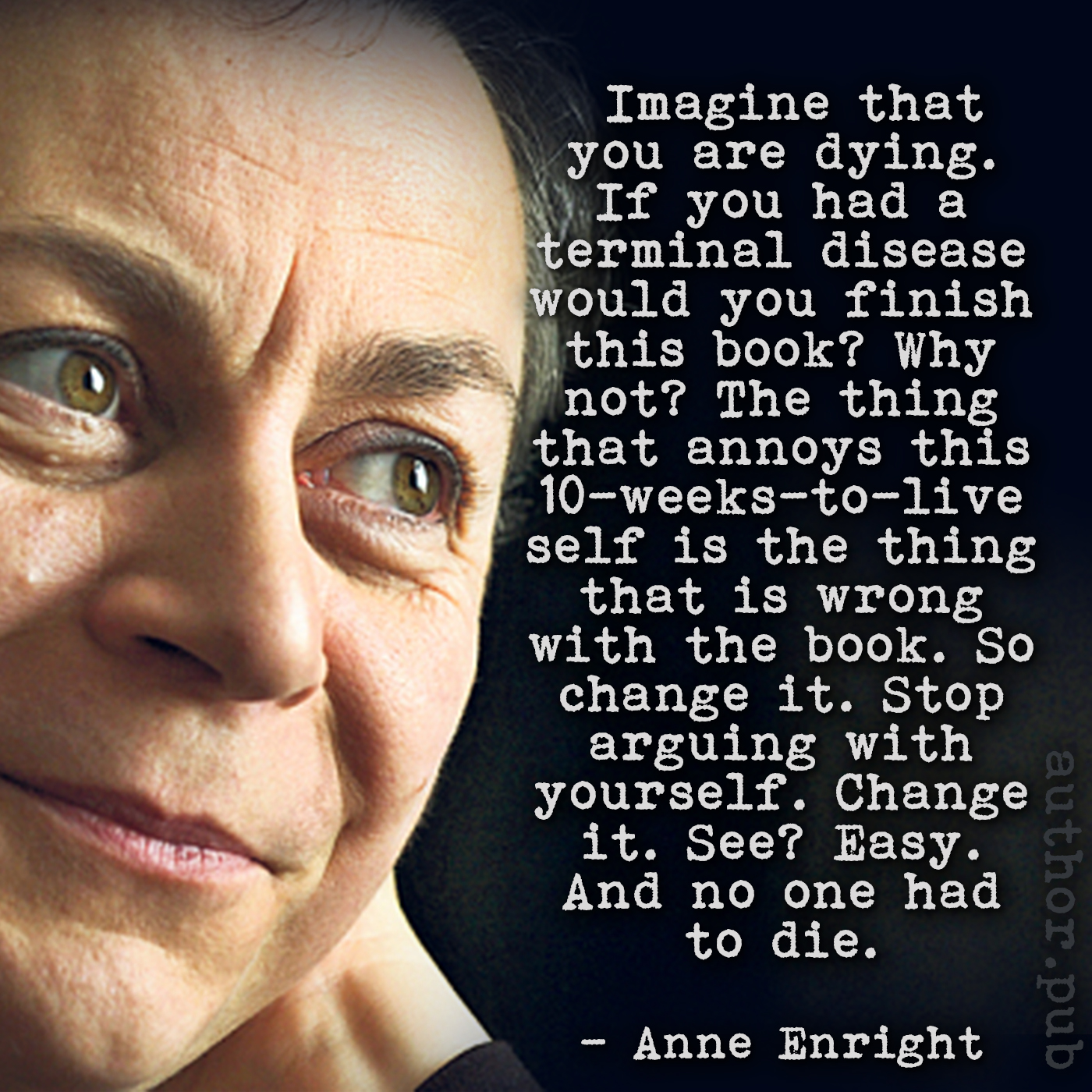
Stop arguing with yourself. Change it. See? Easy. And no one had to die. – Anne Enright


Anne Teresa Enright FRSL is an Irish author. She has published novels, short stories, essays, and one non-fiction book. A Fellow of the Royal Society of Literature, her novel The Gathering won the 2007 Man Booker Prize.
Imagine that you are dying. If you had a terminal disease would you finish this book? Why not? The thing that annoys this 10-weeks-to-live self is the thing that is wrong with the book. So change it. Stop arguing with yourself. Change it. See? Easy. And no one had to die. – Anne Enright

Don’t take anyone’s writing advice too seriously. – L. Grossman


Lev Grossman is an American novelist and journalist, notably the author of the novels: Warp, Codex, The Magicians, The Magician King, and The Magician's Land.